> Society > Local History


Soaring of jet engines in the sky and blaring of signals on the streets, all in a jiffy to reach their respective destination shape the contemporary dynamics of Pan bazar, Guwahati. As one of the oldest economic centres in the city, a single step along Pan Bazar’s busy pavements divulges one to a wide array of spectacles- blaring of signals, honking cars, cacophony of rickshaws, minor debacles dissolving into jubilant laughter and the street’s familiar aroma drifting from nearby bakeries elevated by the shimmering of tea leaves in a kettle. In the midst of that flow, one suddenly comes across a shop bearing a blue sign with bold-white engravings that spell, Assam Optical Co est. 1937.
For many, the city’s ceaseless motion briefly slips out of rhythm when they pause and notice a name that seems oddly familiar. And then, a quiet sense of Déjà vu settles in when the gaze gently falls on the sign. A gentle tug at the far weave of the mind, suddenly paints a scene- a scene of the past when the streets of Pan Bazar carried a different visual of what it used to be and how life moved at a different pace. And amidst the changes-buildings rising, crowds thickening, tastes evolving-one aspect that has remained same across memories, is the shop with its bold-white presence marking Pan Bazar’s streets.
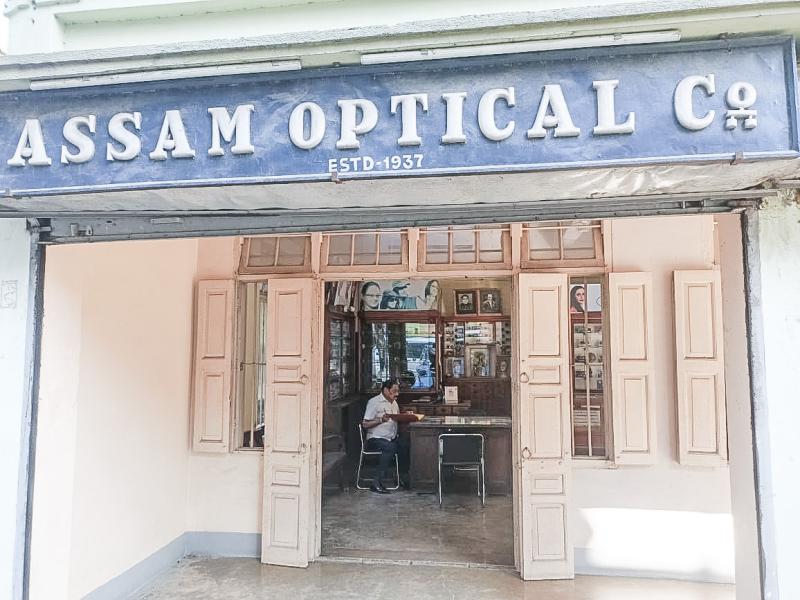
Photo - Rohit Pathak
A name that invokes a multitude of emotion, where stories of yesterday bridge with realities of today, this timeless landmark with its steady energy and pristine aura continues to hold a remarkable grasp over the people who move around it. For some, it holds a desire to rekindle with the past, some with curiosity over the architectural structure, some with a nod of appreciation over its everlasting presence and most with a short gleam on their face underlying an identity shared with the shop’s existence.
A step through Assam Optical’s gentle granite floor, crossing the aluminium doors and windows, and we find ourselves standing amidst the shop’s inner space. And then everything falls quiet.
Pages of stories, scenes in movies, strokes of paint and words of a silver tongue often describe an oasis- a tranquil paradise tucked inside a larger world. Stepping into the shop brings that feeling to life when a surreal moment of calm settles in, and the only sounds heard inside are the soft murmur of the management and the steady hum of ceiling fans. It feels as though the entire building has been quietly tucked away from the restless glare of Pan Bazar’s urban whirl. And then follows a gentle stroll through memory lanes when one notices the crafted heritage of wooden cabinets and tables that are varnished to its absolute perfection, standing tall within a space that recreates the nostalgic image of its former self.
Soon, the memory’s wistful drift follows an immediate shift to the present when the eye catches latest collections of eyewear gleaming past the transparent glass panes, wiped to its pristine clarity. The shop’s coherent organizational structure driven by the management then comes into view where customers are provided with the balanced experience of self-browsing and mindful assistance. Ample space to browse, seating arrangements that host five to six, a well curated collection of eye wear and an overall responsive staff; all offer a small but telling glimpse into a shop shaped by ninety years of legacy.
And then, in the far-left corner of the shop, sitting across a table and busily scribbling on a memo, sits Kumud Chandra Das, the current proprietor of Assam Optical Co. Carrying within him a generational wealth of ideas, memories, experience and lived history, his presence feels steady, almost rooted, like someone who knows the heartbeat of the place without needing to say much. When asked about the secret behind the shop’s success, Das speaks of a generational toil of hard work and perseverance that began with his father, Manik Das.
In the early twentieth century, when the streets of Kolkata carried its decadent prowess as an economic hub, working in one such shop and exposed to the city’s vivacities was Manik Das. It was amidst the ritual humdrum of working and exploring Kolkata that Manik Das first realised his vision of establishing an optical business in Assam. Once in Guwahati, he began the process of manifesting his vision. Working alongside his confidante, Upendra Lal Dutta, the shop was initially founded in Hem Baruah Road, opposite Cotton College Arts building.
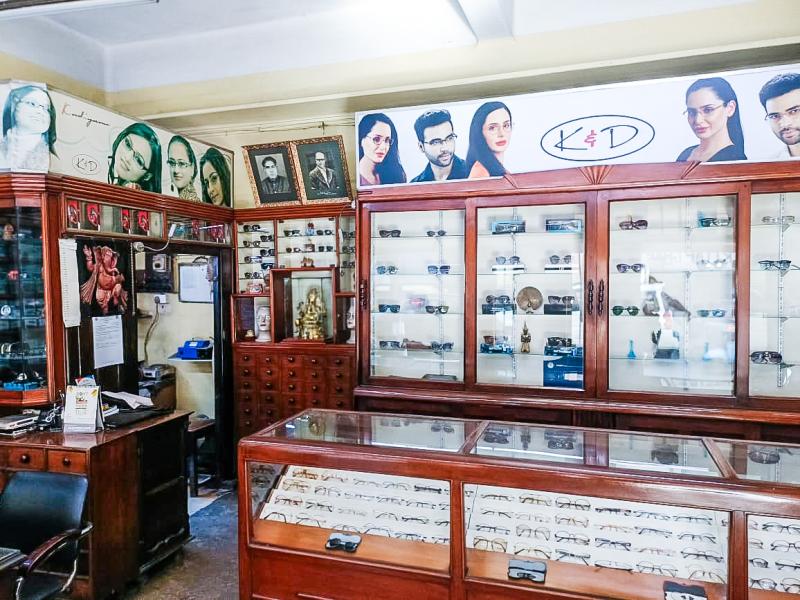
Photo - Rohit Pathak
To spread the word, both Manik Das and Upendra Lal took it upon themselves to travel across the city, often visiting notable households, taking precise measurements, and crafting personalized eyewear. In fact, as part of its marketing campaign, Assam Optical Co regularly conducted eye-checkup camps across various parts of the state, where close-up examinations and personalised eyewear were provided on a large scale. This gesture gradually expanded Assam Optical’s presence in the minds and conversations of customers, igniting the steady rise that would soon define its ascent.
As orders proliferated and customers frequented, the shop finally cemented its reputation for reliability and care, anchoring its name across the city’s murmurs. Hence, a simple desire of providing an entire region with a medium to see, took its desired form when the shop finally shifted to Pan Bazar’s Motilal Nehru Path, near Nagkata Pukhuri, with its familiar signboard gleaming “Assam Optical Co est. 1937”. In fact, when frequent visits by notable personalities- Assam’s first chief minister Gopinath Bordoloi, second chief minister Bishnuram Medhi, veteran media personality Tulsi Govinda Baruah -became a common sight, the shop evolved into a legacy-laden institution that carried a generational wealth of memories, histories, and lived experiences, resonating deep within the Assamese citizens.
Since taking over in 1976, Kumud Das has witnessed a grand transformation across the city that include emerging brands, growing infrastructures, shifting economy and changing demands. From a time of hand-driven machineries shaping every product, to the present era of using industry-made goods, a lot has changed. The primitive tools once central to the craft have gradually given way to modern machinery, the German and Britain made frames of previous century used by the shop have been replaced by contemporary made in India products and the rates, once as modest as ten rupees, have been dealt a two-thousand-rupee markup, per piece.
Yet, navigating across this transformation is Assam Optical Company’s unwavering commitment to quality and service. Adapting to evolving customer needs, meeting contemporary demands for stylized frames, offering imported materials in the earlier years, or embracing modern designs in the present; the generational motto of adhering to customer needs and providing high-quality products never changed. Das highlights that people come with a voice in their hearts, “We will get the right match in Assam Optical.”
He further talks about the emerging competitions in the form of stylized frames and precision lenses finding a momentum amidst the new generation and emerging optical chains throughout the city. However, he believes, it is the trust and expectation maintained by the shop coupled with its highly adaptive nature that has allowed Assam optical to function and proliferate throughout the years. Today, most of the spectacles are sourced from Mumbai and Kolkata, allowing the shop to further stay aligned with contemporary trends.
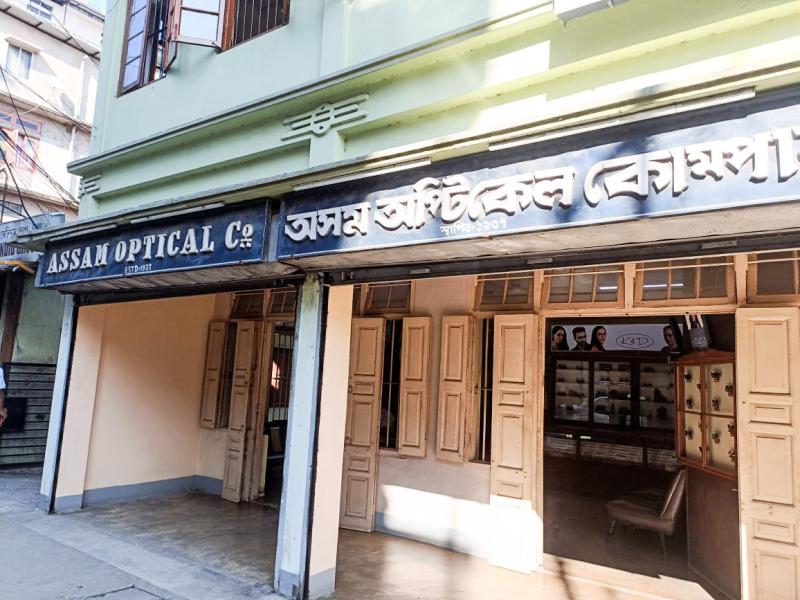
Photo- Rohit Pathak
The translation of Assam Optical Company’s exquisite presence then follows a transition into a meaningful conversation with one of its most loyal patrons, further grounding the shop’s timeless aura. Satyen Sharma, a senior advocate in Gauhati High Court, mentions his first visit to the shop, which was in the year 1983. It was Sharma’s mother, Anupama Devi, whose frequent visits marked his decades of return through Assam Optical’s aluminium doors. “Dukan Khon mur family member or dore” (The shop is like a member of my family) he informs, highlighting a relationship with the shop and it proprietor that exist beyond an economic level. Why, Sharma informs it is the trust and belief that the shop has forged, a bond that continues to draw him across its humble doors, despite the availability of multiple alternatives around the city.
He further emphasises upon the steady narrative Assam Optical has maintained for a near century, which is rooted in the shop’s twin motto of quality assurance and customer satisfaction. This is highlighted by Sharma with an example. When purchasing bifocal lens, he explains, the shop initially provided him with a trial pair, as it takes time for one’s eyesight to adjust to bifocal vison. It was only when Sharma got accustomed to the lens that Kumud Das offered him with the prescribed pair. Therefore, this example is an insight over the shop’s long practiced craft as well as lived experience of catering to personalised needs, driving its ninety year-long unique legacy. The ‘personal touch’ as informed by him- tekhetxokole jaane je moi kenekua pindhi bhal pau (they know what i like to wear)- anchor’s the shop’s presence in Satyen Sharma’s life, thereby guiding him back through its familiar corridors, time and again.
Thus, a generational perseverance striving for attention to detail and emphasis in customer satisfaction draws out the success story behind the near-century long presence of Assam optical as a timeless landmark. The trust it continues to earn and the fortitude it continues to display are core elements behind sustaining a legacy of returning customers and attracting new ones. And not just Kumud Das, the manager of the store, Himangshu Dey, who has served in Assam Optical for decades, shares a similar belief in perseverance and flexibility, which he sees as forces driving the shop’s continued growth. So, a structure that seems to hold itself apart from the outside world while existing across a serene vestibule of calmness and tranquillity is the Assam Optical Company.
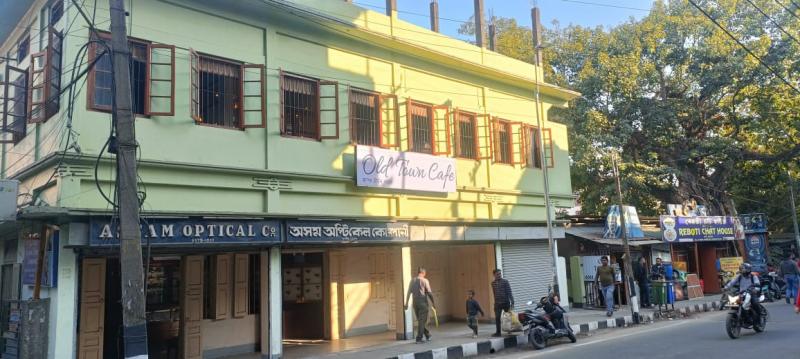
Photo - Rohit Pathak
Striking a harmonious balance between public engagement and private meet, the shop often mediates between the city’s kinetic energy and the visitor’s need for respite. Filled with traditional Assamese ornaments that stir nostalgia while adapting to the sensibilities of a modern audience, it becomes a resonant blend of traditional and modern, connecting people from various walks of life. And as an architectural structure, it seems to have found a harmonious co-existence with a café built right on top of it. Created by the third generation Das lineage, Old Town Café now presides over Assam Optical, symbolizing a harmonious interplay between preserving heritage and embracing evolving contemporary needs.
So, what began as a small spark- a simple desire to serve the people of Guwahati- has grown into a near century long blaze, a radiant torch illuminating across the passage of time. Today, the shop is not merely a threshold of economic transaction but a timeless Assamese landmark, an enduring structure standing strong amidst the sands of time and memory. Its walls hold a generation of stories and its counters still greet customers like before. Small things have changed, minute shifts have appeared and faded, yet the spirit lingers, drawing customers gently within its enduring bosom.
Rohit Pathak
 Navigations
  Quick Contact
 Subscribe Us
 Quick Mail